
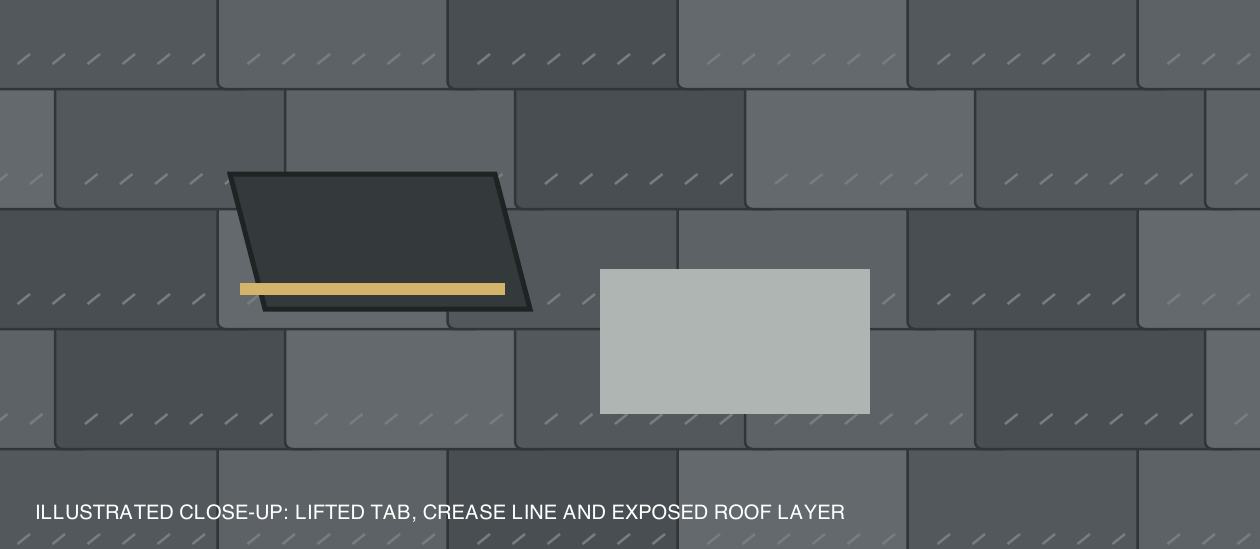
What wind changes
Asphalt shingles rely on fastening, seal strips, overlap, and the integrity of the shingle mat. Wind pressure can lift a tab, break its adhesive bond, bend it backward, or create a crease across the mat.
A lifted tab may settle back into place after the storm. That does not necessarily restore the original seal or reverse a crease. This is why a ground-level glance cannot answer the repair question.
- Lifted or unsealed tabs
- Diagonal or horizontal crease lines
- Tears or missing shingle material
- Exposed fasteners or displaced accessories
- Repeating patterns on similarly oriented slopes
Why one photo is not enough
A responsible inspection preserves both context and detail: the building, elevation, roof slope, surrounding shingle field, and close-up condition. A crease near a penetration means something different when the surrounding tabs are loose, brittle, or previously repaired.
Document the location, slope orientation, seal condition, fastening, surrounding pattern, and repairability—not just the most dramatic close-up.
The repairability question
The technical question is not simply whether a shingle is damaged. It is whether an isolated repair can be performed without causing collateral damage to adjacent material and whether a reasonably compatible shingle is available.
Age, brittleness, adhesion, discontinued dimensions or colors, and surrounding conditions can all affect that answer. Repairability is building-specific and should be documented rather than assumed.
What to do after a wind event
- Photograph visible conditions from the ground without climbing onto the roof.
- Record the storm date, reported leaks, loose material, and affected elevations.
- Arrange a qualified roof inspection when conditions are safe.
- Notify the insurer or broker when the policy requires prompt notice.
- Authorize temporary stabilization separately from permanent repair when necessary.
Do not create, exaggerate, or disturb damage for a photograph. Preserve the condition and let qualified professionals document it.
PRIMARY SOURCES & FURTHER READING