
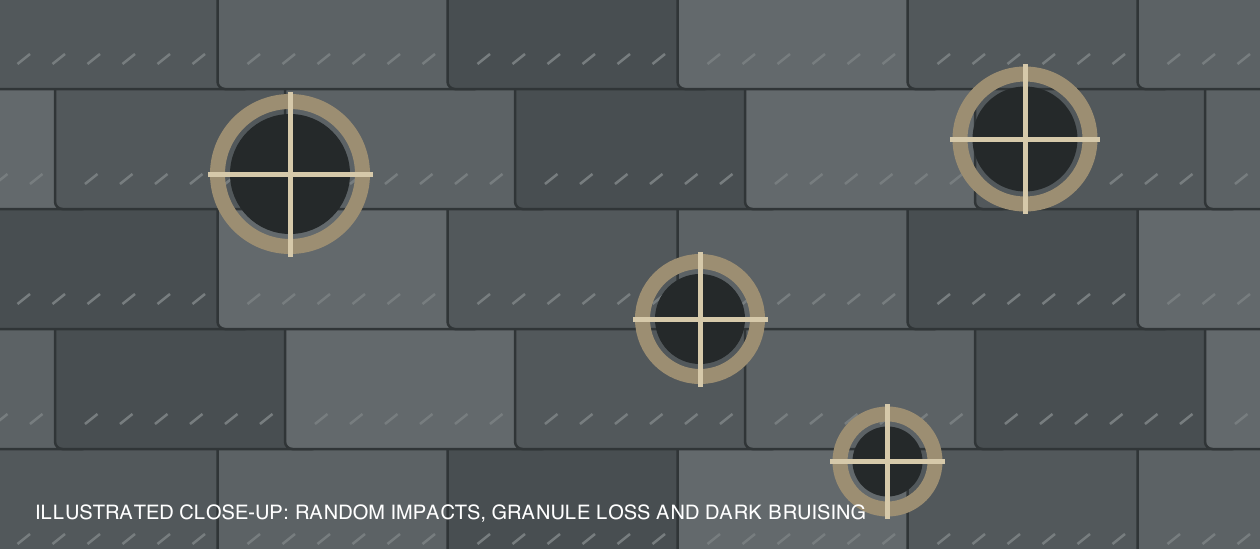
What inspectors look for
Potential hail indicators can include circular or irregular impact marks, localized granule displacement, bruising or mat disruption, and collateral marks on metals or other exposed components.
No single characteristic automatically proves the date, cause, or coverage of a condition. The strongest documentation connects individual marks to a broader pattern and to the rest of the property.
- Random rather than directional distribution
- Localized granule displacement
- Soft or fractured mat beneath an impact
- Collateral indicators on vents, gutters, screens, or soft metals
- Consistency across slopes exposed to the same storm
What hail can be confused with
Blisters, manufacturing artifacts, mechanical scuffs, foot traffic, algae, age-related granule loss, and tool marks can resemble storm damage in a close-up photograph. That is why context and hands-on evaluation matter.
An ethical inspection records conflicting evidence too. The goal is not to make every mark fit a claim; it is to describe what is actually present.
Why the pattern matters
A credible hail investigation includes representative test areas, roof-wide context, slope orientation, material age, storm history, and collateral surfaces. Random impact distribution is generally more informative than a single isolated circle.
For an HOA or townhome community, the same framework should be repeated building by building. Conditions on one roof do not automatically establish identical damage on every structure.
One building can justify looking closer at the community. It does not guarantee the same condition or coverage everywhere.
From inspection to decision
- Preserve overview and close-up photographs.
- Map the evidence to the correct structure, elevation, and slope.
- Separate storm indicators from leak details and installation defects.
- Compare observed conditions with the policy and storm history.
- Let the carrier make the coverage determination under the policy.
A roof contractor documents conditions and repair options. The insurer determines coverage. Neither should be confused with the other.
PRIMARY SOURCES & FURTHER READING